This guide contains Amazon affiliate links. As an Amazon Associate we earn from qualifying purchases, at no extra cost to you. How we choose what to link.
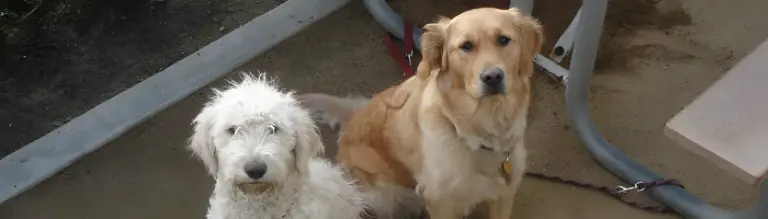
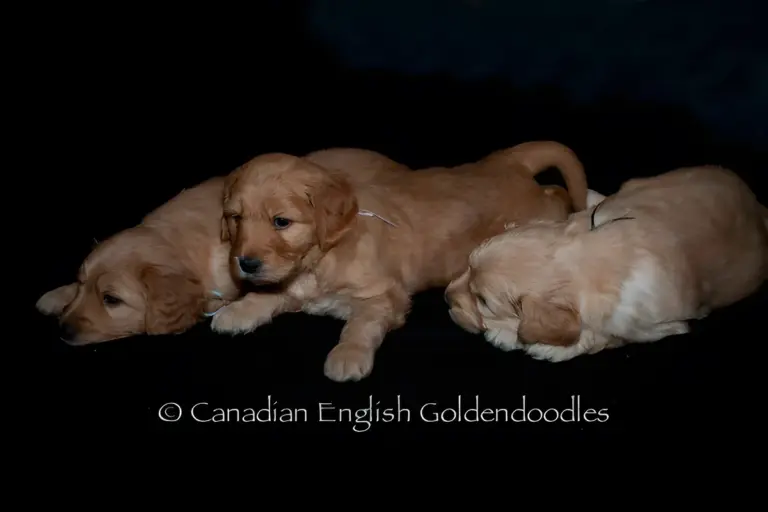
A Goldendoodle is a cross between a Golden Retriever and a Poodle. At their best they combine the Golden’s gentle, people-loving nature with the Poodle’s intelligence and low-shedding coat, which is why they’ve become one of the most popular family dogs in North America. We bred English Goldendoodles for years, and this guide covers what we’d want any family to know about the breed: where it came from, temperament, sizes, coats, generations, exercise, lifespan, and who it suits.
Where Goldendoodles came from
Crossing Poodles with other breeds became popular after the Labradoodle was developed in Australia in 1989, bred as a guide dog that might suit people with allergies. Golden Retriever × Poodle crosses followed, and the Goldendoodle took off in North America and Australia during the 1990s. Some earlier crosses are reported; Wikipedia, for example, credits author Monica Dickens with one in 1969. Goldendoodles aren’t recognized as a breed by the major kennel clubs such as the CKC and AKC. They’re a crossbreed, often called a “designer dog”. We go into what that means, and why we don’t think it’s an insult, in our guide to designer dogs and Goldendoodle generations.
Temperament: smart, gentle and people-focused
Both parent breeds are known for intelligence. In Dr. Stanley Coren’s well-known ranking of working and obedience intelligence in The Intelligence of Dogs, which most other rankings trace back to, the Poodle is #2 and the Golden Retriever #4. That’s a big part of why Goldendoodles are usually quick to learn and eager to please.
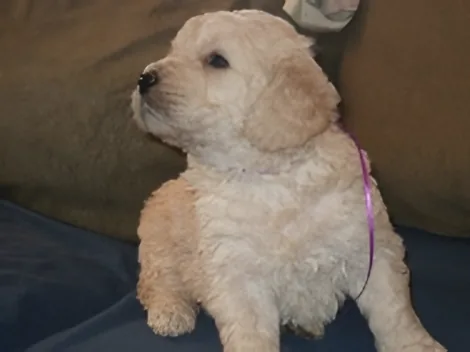
Temperament was the single most important thing we bred for. The best Goldendoodles are friendly, affectionate, gentle with children and sociable with other dogs. A few honest caveats from our years with them:
- They are people dogs. Most Goldendoodles want to be with their family and don’t do well left alone for long days. Boredom and loneliness can turn into chewing, barking or digging.
- “Friendly” isn’t “calm” at first. Young Goldendoodles are bouncy, mouthy and enthusiastic, and without training that can mean jumping on visitors. Early socialization and a good puppy class make a huge difference. See choosing a trainer.
- They make poor guard dogs. Most will greet a stranger like an old friend.
- Individual puppies vary. Temperament depends on the parents and how the litter was raised as much as on the breed. That’s why we put so much effort into matching puppies to families.
Goldendoodle sizes
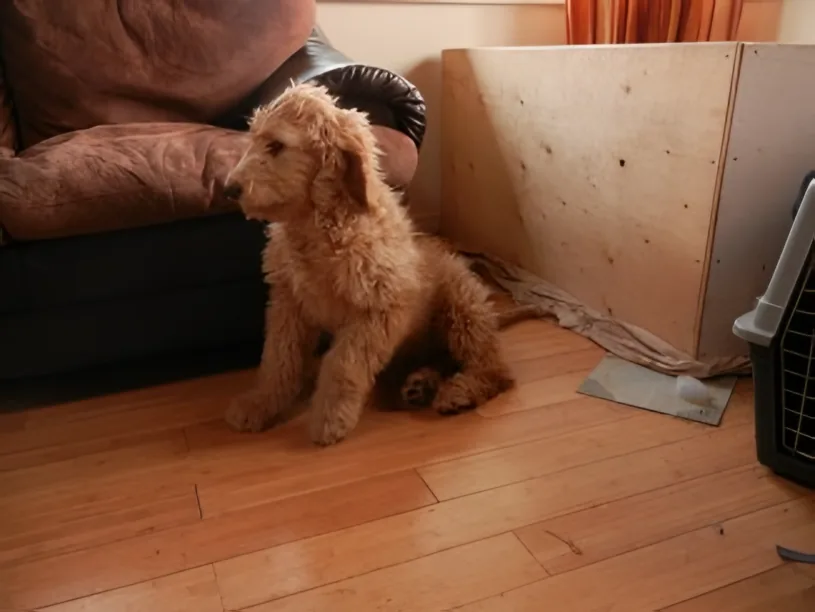
Goldendoodle size comes mostly from the size of the Poodle parent. Breeders don’t all use the same terms, but typical ranges are:
| Size | Typical height (at shoulder) | Typical adult weight |
|---|---|---|
| Miniature | up to about 20 in (51 cm) | roughly 15–35 lb (7–16 kg) |
| Medium | about 17–20 in (43–51 cm) | roughly 35–50 lb (16–23 kg) |
| Standard | about 20–25 in (51–64 cm) | roughly 50–80 lb (23–36 kg), sometimes more |
Our own Goldendoodles were standard-sized from English Golden Retrievers and Standard Poodles, and most matured at around 50–95 lb depending on the litter and whether they were male or female. Even within one litter, sizes can vary quite a bit. Ask a breeder what the parents weigh and what past puppies grew to, rather than relying on a label. Smaller sizes are often called “mini”, “toy” or “petite”. These come from Miniature or Toy Poodle parents (or smaller Goldendoodle parents), and the size categories are much less standardized.
Coat types and grooming
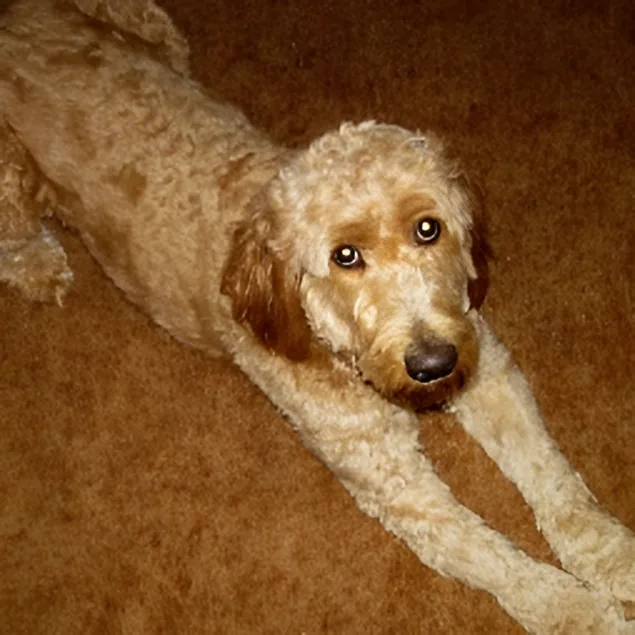
Goldendoodle coats range from fairly straight (more like a Golden) through wavy or “shaggy” to tightly curly (more like a Poodle). Coat depends on a few well-understood genes, which is why generation and parentage matter. Wavy and curly coats tend to shed less, but they also mat easily, and every coat type needs regular brushing plus a professional groom roughly every 6–8 weeks. We had a lot of fun over the years with all the different ways you can groom a Goldendoodle. Our Goldendoodle grooming guide covers coat types, tools and a realistic schedule.
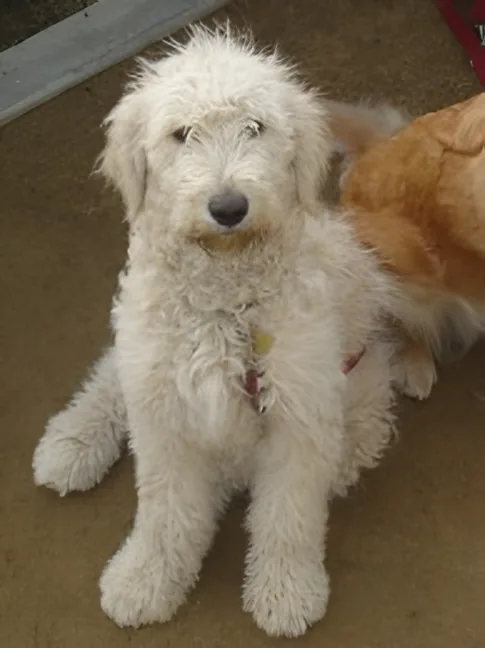
Goldendoodles come in a wide range of colors: cream, apricot, gold, red, chocolate, black, gray and parti (two-colored). Many puppies lighten or change shade as they grow.
F1, F1B, F2: what the generation labels mean
An F1 Goldendoodle has one purebred Golden Retriever parent and one purebred Poodle parent. An F1B is an F1 crossed back to a Poodle, which usually means a curlier, lower-shedding coat. F2 and multigenerational Goldendoodles come from Goldendoodle-to-Goldendoodle breeding. Our generations guide explains each one with a comparison table.
English vs American Goldendoodles
An “English” Goldendoodle is bred from an English-type (British-style) Golden Retriever rather than an American-type Golden. English Goldens tend to be stockier, with broader heads and often lighter cream-to-gold coats. American Goldens are usually leaner, with a narrower head and often a darker gold or red coat. Those traits carry through to the puppies to some degree. We compare the two in detail, including the claims you’ll hear about temperament and health, in English vs American Goldendoodle.
Why we chose English Golden Retrievers
Before we bred Goldendoodles, we bred Golden Retrievers, specifically English Golden Retrievers. We chose them largely because of the strong emphasis on avoiding inbreeding and line-breeding in the lines we worked with. Genetic diversity mattered a great deal to us as holistic breeders. When we brought home our first English Golden Retriever, her pedigree went back 20 generations without a single crossed line, compared to roughly 5 generations in the typical American retriever pedigrees we had looked at. That genetic-diversity focus is what led us to Goldendoodles in the first place.
What about “Teddy Bear” Goldendoodles?
You’ll often see “Teddy Bear Goldendoodle” used, and we used it ourselves. To be clear, it isn’t a separate breed or a registered type. It’s a descriptive, and often marketing, term for Goldendoodles with a plush coat, round face and short muzzle, a look many English-line Goldendoodles have. A puppy called “Teddy Bear” by one breeder may look quite different from another breeder’s. So judge the parents, their health testing and the puppy’s temperament, not the name. The “teddy bear” look is also partly a grooming style: a rounded face trim can give almost any Goldendoodle that look.
Exercise and energy
Goldendoodles are active dogs from two working breeds, the Golden a gundog and the Poodle originally a water retriever. A healthy adult standard Goldendoodle typically needs at least an hour of exercise a day: walks, off-leash play in a safe area, fetch, or swimming (most love water). They need mental exercise too: training, puzzle toys and games. Puppies need shorter, gentler sessions while their joints are developing. Short walks and free play are better than long runs or repetitive jumping until your vet says their growth plates have closed.
Health and lifespan
Most Goldendoodles live about 10–15 years, with smaller dogs tending toward the longer end. Crossing two breeds can bring some “hybrid vigor”, but it doesn’t cancel out inherited conditions. A Goldendoodle can still inherit problems common to either parent breed, such as hip and elbow dysplasia, certain eye diseases, a heart condition called subvalvular aortic stenosis, and some cancers. Their floppy, hairy ears are also prone to infections. That’s why health testing of both parents matters so much. See our Goldendoodle health guide for what to look for.
Are Goldendoodles hypoallergenic?
Sometimes, for some people. Low-shedding coats seem to suit many allergy sufferers, but all dogs produce allergens, and studies haven’t found lower allergen levels in homes with “hypoallergenic” breeds. The individual dog matters most. Our hypoallergenic dogs guide explains the research and gives practical steps.
Who is a Goldendoodle right for?
A Goldendoodle is often a wonderful fit for:
- families with children, where the dog will be part of daily life rather than left outside
- active people who enjoy walks, hikes and play every day
- first-time dog owners willing to commit to training
- people with mild allergies, after spending time with the specific dog
A Goldendoodle may not be the right fit if:
- the dog would be alone most of the day, most days
- you want a low-maintenance coat, since grooming is a real cost in both time and money
- you need a quiet, low-energy apartment dog (consider a smaller size, or a different breed)
- you want a guard dog
Free: the Goldendoodle Puppy First-Week Checklist
A printable checklist of what to buy, what to book and what to do in the first seven days, from our years raising English Goldendoodle litters. We will also send a few short emails with our best puppy-care guides. No sales, and you can unsubscribe at any time.
The signup form didn’t load in your browser (ad blockers and some security software hide it). Open the signup form in a new tab.