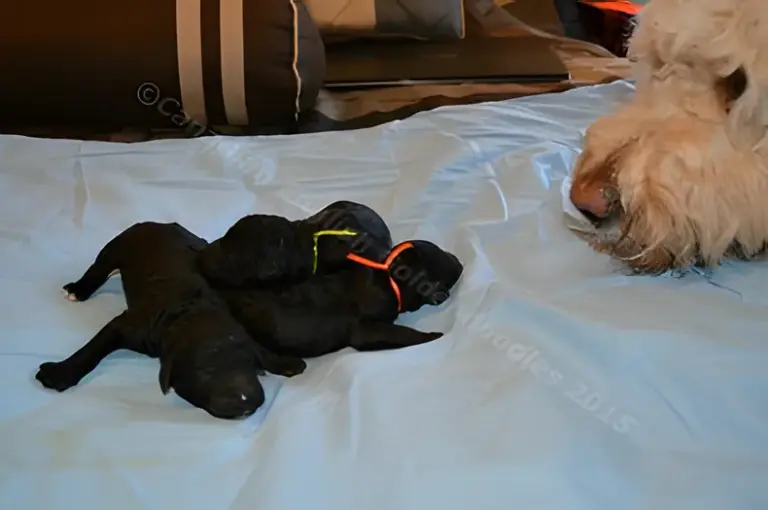
The theory behind Early Neural Stimulation (ENS) is that applying a small amount of stimulation or stress in a safe environment produces stronger, more resilient puppies who grow into stronger, more resilient dogs. We looked at this the same way we looked at everything else — comparing a purely natural setting to life in our home, with the general rule of holistic breeding being to only intervene when necessary.
Does it make sense to intervene at all?
Puppies born in the wild would naturally be exposed to more mild stress early on than they would in a living room. Does it make sense to try to replicate that? Looking at it holistically: muscles don’t get stronger without resistance, and immune systems weaken without exposure to foreign invaders. Stimulating a body and then nurturing it back to a normal state teaches that body to minimize its own stress response over time — to learn that a given stress is “no big deal.” But too much of a good thing is never a good thing: over-stressing a puppy can cause it to stop thriving, and can cause real neurological harm. Finding that balance is the whole point.

Dr. Battaglia’s ENS protocol
Dr. Carmen Battaglia has done well-known research on Early Neural Stimulation, weighing both the risks of over- and under-stressing a puppy. His program consists of five brief sensory exercises, performed once a day from day 3 to day 16:
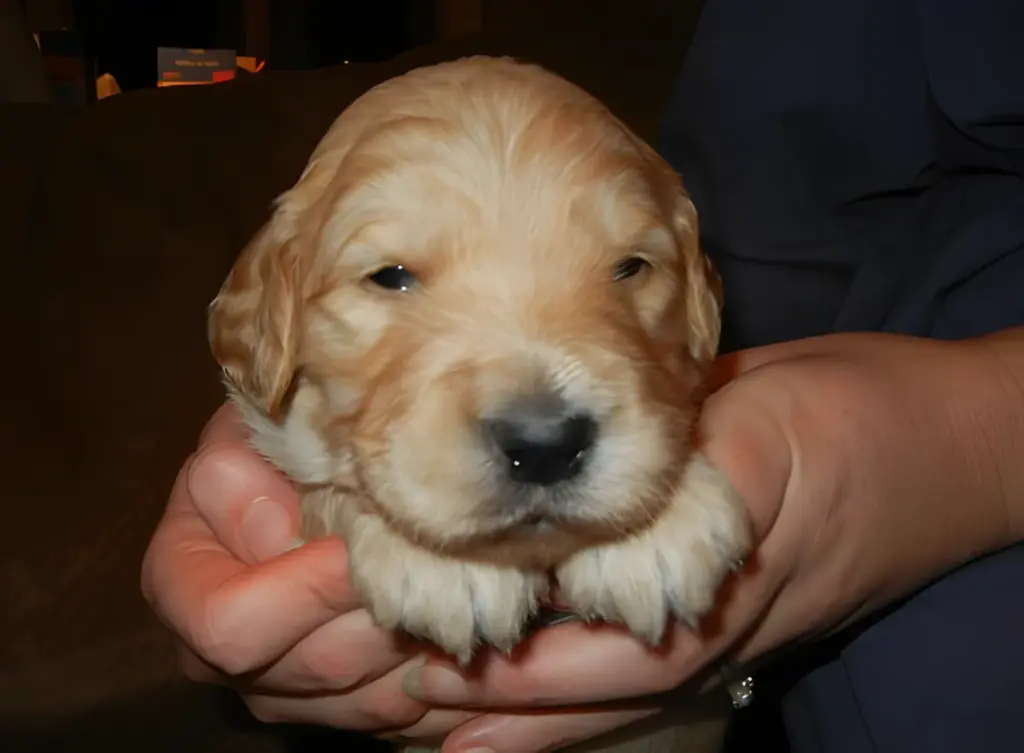
- Tactile — tickle a Q-tip between the puppy’s toes for three seconds.
- Head held erect — hold the puppy with its head directly above its tail for three seconds.
- Head pointed down — reverse that hold for three seconds.
- Supine position — cradle the puppy on its back in your hands for three seconds.
- Thermal — place the puppy’s paws on a cool surface for three seconds.
None of these look overwhelming on their own — which is exactly the risk. It would be easy to hold a puppy on its back a little longer than intended, or set it on a cold floor while cleaning its bed, without ever realizing you’d overstimulated it. Being aware of the protocol’s intent matters as much as the exercises themselves.
Is any of this actually “natural”?
There’s nothing natural about a perfectly heated house and soft blankets washed daily, either — so the real question is whether these mild stimulations offer a more natural introduction to the world a puppy would eventually meet anyway. Each of the five exercises maps onto something a puppy could plausibly encounter in a den in the wild, which is a reasonable case that the protocol, done properly, sits closer to natural than not.
It also engages the puppy as a whole: physical stimulation is obvious, the supine position (submissive for any canine) brings in an emotional component, and reorienting the puppy repeatedly requires it to mentally process the change each time. And critically, there’s always a way back to balance built in — the puppy’s mother. Her warmth, her smell, her presence are all it takes at that age. Much like an infant learning to trust its parents through being stimulated and then comforted, a puppy learns the same lesson: everything is okay, and once he’s back at his mother’s side, it really was no big deal.
What does the research actually show?
It’s worth being honest about the evidence. ENS grew out of a U.S. military program called “Bio Sensor” (later popularized as the “Super Dog” program), which reported that stimulated puppies had better heart and adrenal function, stress tolerance and disease resistance. Dr. Battaglia’s writing brought those exercises to breeders, but the original military findings were never published in a way that lets others check exactly what was measured.
Independent studies since then are few and mixed. A study of mine-detection dog puppies found no measurable difference between ENS puppies and puppies that were simply handled, which the researchers put down partly to the enriched socialization all the puppies already got. A 2022 study in commercial breeding kennels likewise found no improvement in health or stress responses from ENS. A study of Israeli military working dogs did find some differences, but only when the dogs were 10 to 12 months old.
Our take: done gently and briefly, ENS is very unlikely to do harm, and it gets a breeder handling every puppy every day. But it isn’t a shortcut. The research points to the same things we always cared about most: a calm mother, lots of gentle handling, and rich, positive socialization from three weeks on. Those matter far more than any single exercise.
Sources
- Boone et al. (2022), “The Effect of Early Neurological Stimulation on Puppy Welfare in Commercial Breeding Kennels,” Animals (also summarizes the mine-detection and military dog studies)
- Battaglia, “Early Neurological Stimulation,” Breeding Better Dogs
Free: the Goldendoodle Puppy First-Week Checklist
A printable checklist of what to buy, what to book and what to do in the first seven days, from our years raising English Goldendoodle litters. We will also send a few short emails with our best puppy-care guides. No sales, and you can unsubscribe at any time.
The signup form didn’t load in your browser (ad blockers and some security software hide it). Open the signup form in a new tab.