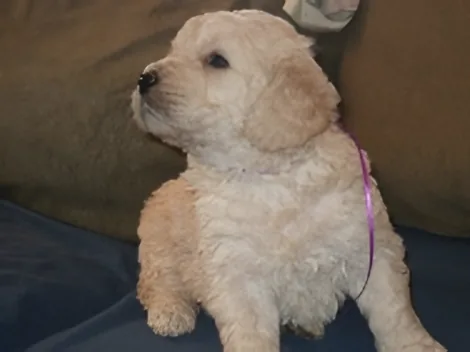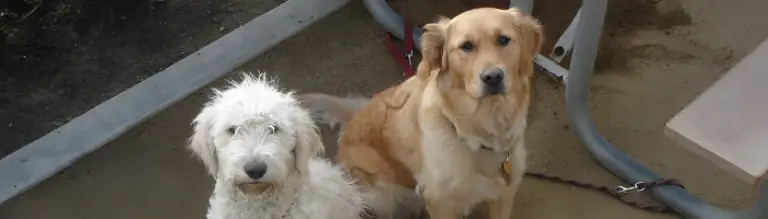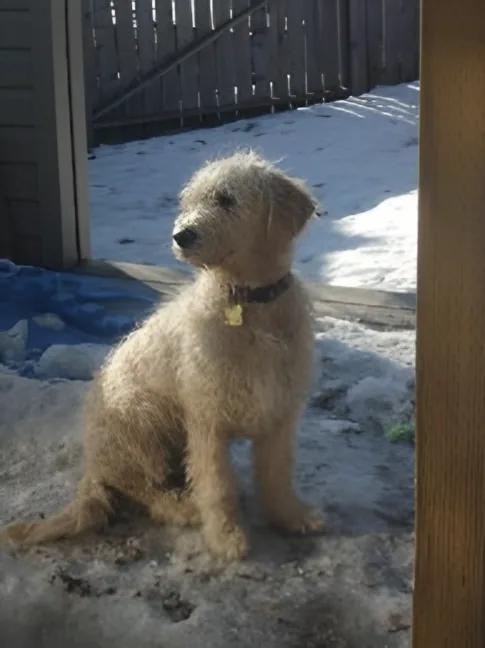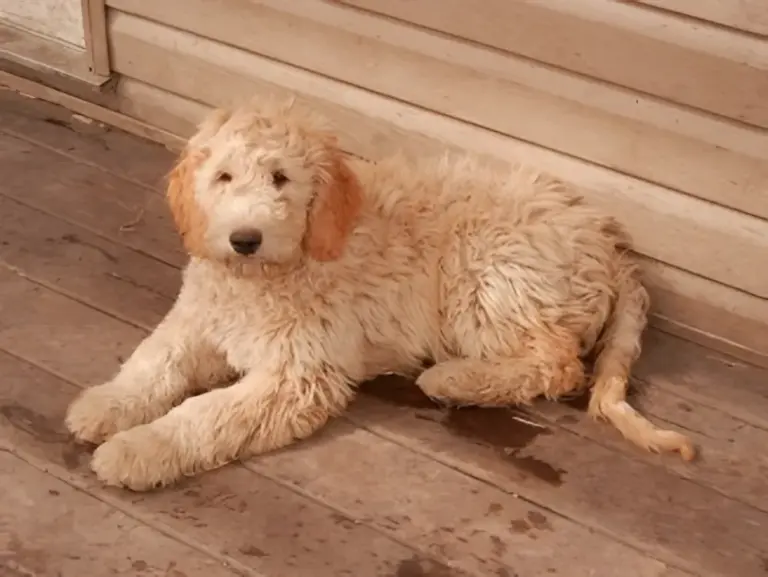
Designer (or hybrid) dogs carry a lot of stigma. Terms like “puppy mill” often get attached in an effort to discredit every cross-breed breeder, careful or not. It’s worth asking: do purebred breeders always know where their own breed came from? Golden Retrievers, for instance, were developed in the Scottish Highlands from 1868 by Lord Tweedmouth. He crossed a yellow wavy-coated retriever named Nous with a Tweed Water Spaniel named Belle. Over the next two decades he added another Tweed Water Spaniel, black retrievers, an Irish Setter and a sandy-colored Bloodhound. If that’s not a “mutt,” what is? Every breed starts the same way: intentional breeders selecting for desired traits, generation after generation, until those traits reliably reproduce.
This page explains what “designer dog” really means, what hybrid vigor can and can’t do, and how to decode the F1, F1B, F2 and multigen labels you’ll see on every Goldendoodle listing.
Hybrid vigor: real, but not magic
What breeders of hybrid dogs have found is that many desirable traits show up from the very first generation. There can be real variation in size, coat type and how much a dog sheds. But crossing two unrelated breeds does tend to bring more genetic variety than breeding within a closed breed. Geneticists call this heterosis, or hybrid vigor. On average it can mean fewer problems caused by two copies of the same recessive gene, and sometimes better overall robustness.
What hybrid vigor doesn’t do is cancel out inherited disease. A Goldendoodle can still inherit conditions that are common in both Golden Retrievers and Poodles, such as hip and elbow dysplasia or certain eye diseases. It can also inherit dominant or complex conditions from either side. And the benefit shrinks when Goldendoodles are bred to Goldendoodles for several generations without care about relatedness. A cross is only as healthy as the parents going into it, which is why health testing of both parents still matters. See our Goldendoodle health guide for which tests to ask about.
Decoding the F1, F1B, F2 labels
- F1: first generation. A purebred Golden Retriever crossed with a purebred Poodle.
- F1B: first-generation backcross. An F1 Goldendoodle crossed back to a purebred, almost always a Poodle.
- F2: second generation. Both parents are F1 Goldendoodles.
- F2B: second-generation backcross. Breeders use this label a little differently. Most often it means an F1 crossed with an F1B, and sometimes an F2 crossed back to a Poodle.
- F1BB: an F1B crossed back to a Poodle again, giving a very Poodle-like coat.
Beyond that, you’ll often see breeders simply use “multigen” (short for multi-generational) for anything further along, such as F3, F4 and beyond. There are two general approaches among designer-dog breeders. One is breeding “the true hybrid” each generation from two purebred parents. The other is working toward a stabilized “new breed” by pairing cross-bred dogs of the same mix together; these puppies are the multigens.
| Generation | Parents | Approx. % Poodle | Typical coat and shedding |
|---|---|---|---|
| F1 | Golden Retriever × Poodle | ~50% | Usually wavy; light to moderate shedding; most variable coat of the “straight” crosses |
| F1B | F1 Goldendoodle × Poodle | ~75% | Usually wavy to curly; low shedding |
| F2 | F1 × F1 | ~50% | Very variable within a litter, from straight to curly; shedding hard to predict |
| F2B | F1 × F1B (most common usage) | ~62.5% | Wavy to curly; usually low shedding |
| F1BB | F1B × Poodle | ~87.5% | Curly, very Poodle-like; very low shedding |
| Multigen | Goldendoodle × Goldendoodle (3+ generations) | varies | Often selected for curly, low-shedding coats; depends on the breeder’s lines |
A word of caution about that table: the “% Poodle” figures are just pedigree arithmetic. They don’t decide the coat. Shedding and curl are driven by a handful of specific genes, including the “furnishings” gene that gives the beard and eyebrows and one for curl. These genes can now be tested. So two F1B puppies from different litters can have quite different coats, and a breeder who DNA-tests coat genes can predict the adult coat far better than one who relies on the generation label.
Many designer breeds are built around crossing with a Poodle specifically, because Poodle-type coats seem to suit many allergy sufferers. That’s likely a big part of why there are so many Poodle-cross designer breeds today. As with any dog, no breed is guaranteed to be allergy-friendly for every person, and research shows it’s the individual dog that matters most. See our Hypoallergenic Dogs page for more.
Finding their role
A successful cross-breed needs two things: reliably reproducible desirable traits, and real demand from the public. Every successful breed in history has found its role in human life: service, hunting, ranching, companionship, protection. Poodle crosses were first bred for work as guide dogs, and today Goldendoodles are popular as therapy dogs, companions and family pets across North America. The term “designer dog” itself has only been in common use for a few decades. It simply describes intentionally breeding two purebred dogs of different breeds for a desired result, which is really just another word for hybrid dog. (Your dog and the neighbor’s dog getting together, on the other hand, still just makes a mutt.)
Free: the Goldendoodle Puppy First-Week Checklist
A printable checklist of what to buy, what to book and what to do in the first seven days, from our years raising English Goldendoodle litters. We will also send a few short emails with our best puppy-care guides. No sales, and you can unsubscribe at any time.
The signup form didn’t load in your browser (ad blockers and some security software hide it). Open the signup form in a new tab.