
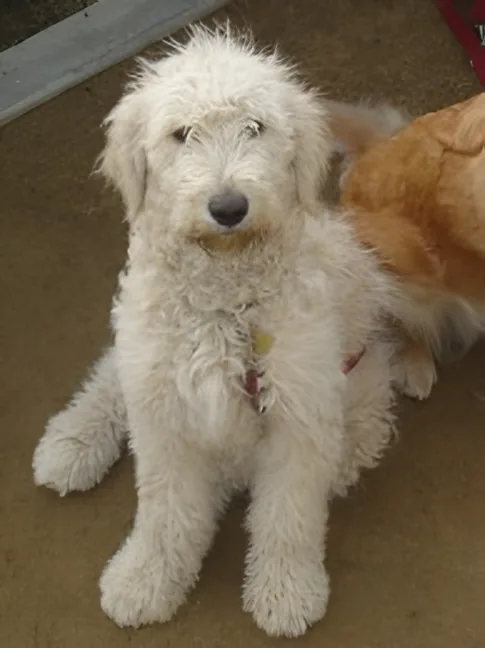
Goldendoodles need more grooming than most dogs. Their coats keep growing, and the low-shedding hair that many families choose them for holds on to loose hair, which tangles and mats if you don’t brush it out. Most Goldendoodles do well with brushing several times a week at home plus a professional groom every 6–8 weeks. How much work your dog needs depends mainly on their coat type. We had a lot of fun over the years with all the different ways you can groom a Goldendoodle. Here is what we learned.
The three Goldendoodle coat types
A Goldendoodle’s coat depends on which genes they inherit from the Golden Retriever and Poodle sides. Researchers have found that three genes explain most of the coat variation in dogs: FGF5 (coat length), KRT71 (curl) and RSPO2 (“furnishings”, the longer beard, eyebrows and leg hair of the classic doodle face). Furnishings are also closely linked to low shedding. That’s why a flat-coated doodle usually sheds more than a wavy or curly one.
Flat or straight coat
This coat looks much like a Golden Retriever’s, often without the doodle beard and eyebrows. It usually means the puppy did not inherit furnishings. It mats less, but it tends to shed more and is less likely to suit allergy sufferers.
Wavy or shaggy coat
This is the classic “teddy bear” look and the most common Goldendoodle coat: loose waves with furnishings on the face. It’s a middle ground. It sheds little or not at all in most dogs and is moderately prone to matting, especially during the puppy-coat change.
Curly coat
Tighter curls, closer to a Poodle coat, and most common in F1B and multigenerational Goldendoodles. It is usually the lowest-shedding coat, but it needs the most brushing, because shed hair stays trapped in the curls.
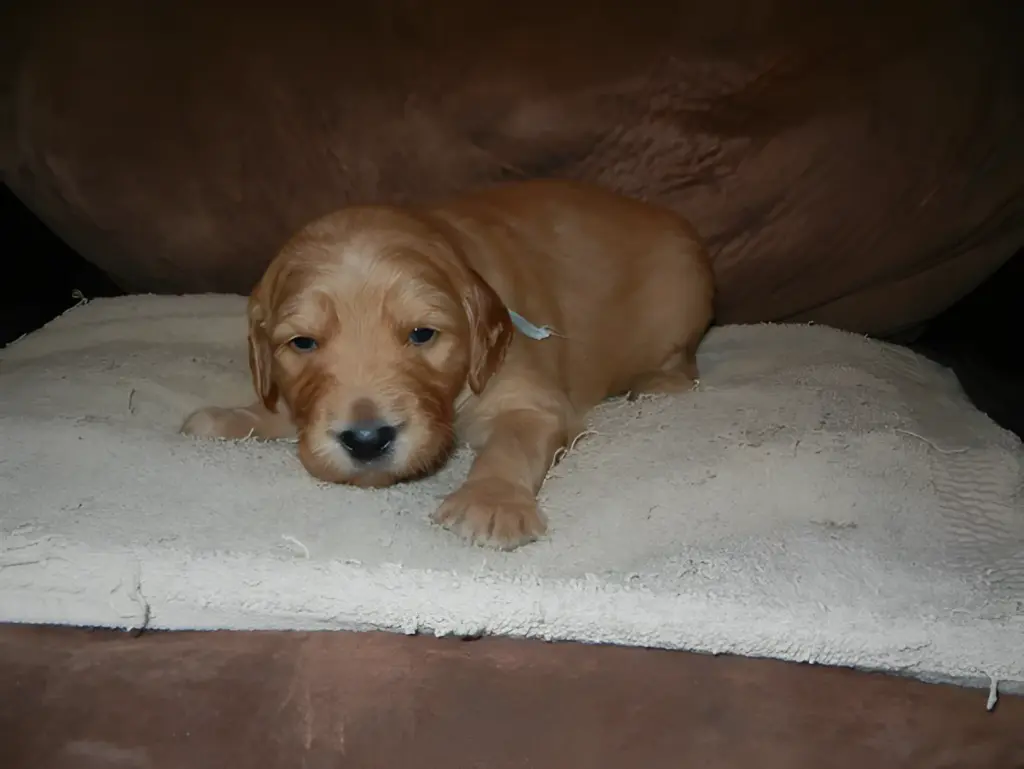
The coat you see at eight weeks is only a hint of the adult coat. A puppy’s face gives the best early clue: a puppy with a visible mustache and eyebrows usually has furnishings. See our hypoallergenic dogs page for what “low-shedding” does and doesn’t mean for allergies.
The puppy-coat transition
Somewhere between about 4 and 12 months, often around 5–8 months, a Goldendoodle begins trading their soft puppy coat for an adult coat. The coat can become fuller and coarser, and very often it suddenly starts to mat. Many owners are caught out here. A coat that was easy last month can be full of tangles this month.
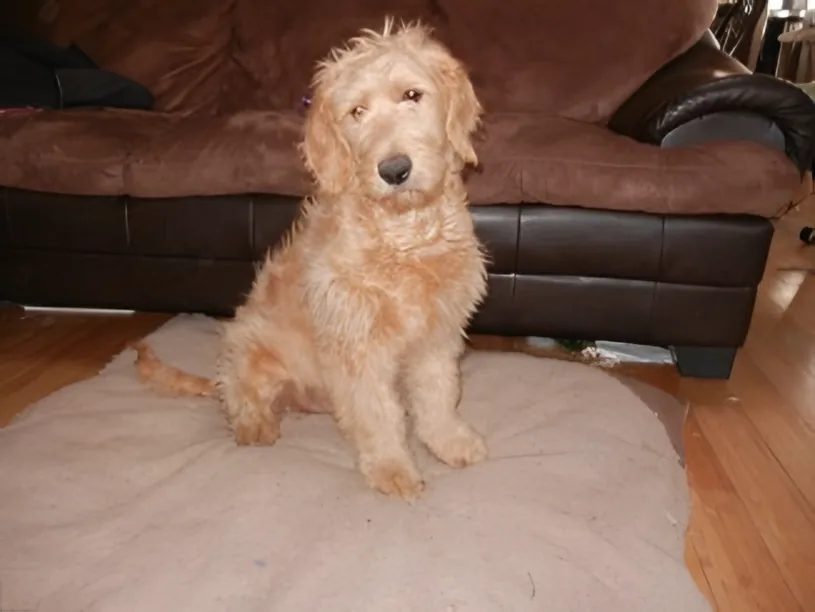
During the transition:
- Brush daily if you can, even for five minutes.
- Book professional grooms a little closer together (every 4–6 weeks).
- Consider keeping the coat shorter until the adult coat has settled. Most doodles show their final coat type by about 18 months.
How to brush a Goldendoodle properly
Brushing only the top layer is the most common mistake. The coat looks fluffy on the surface, while mats build up underneath against the skin. The fix is line brushing:
- Work in sections. With one hand, hold the coat up so you can see a line of skin.
- Use a slicker brush to brush the hair below that line down and away, a little at a time, right from the skin out.
- Move the line up a little and repeat until you’ve covered the section.
- Check the section with a metal comb. If the comb slides through to the skin without catching, that section is done. If it snags, go back with the slicker.
- Be gentle. Pressing a slicker hard against the skin can cause “brush burn”.
Mats form fastest wherever there is friction or moisture, so check these spots every time:
- behind and under the ears, and the ear flaps themselves
- under the collar or harness
- the armpits and the “elbow pits”
- the back of the legs, the paws and between the pads
- under the tail and around the rear
- the beard, which stays damp after drinking and eating
Grooming schedule at a glance
| Task | How often | Notes |
|---|---|---|
| Brushing and combing | Several times a week (daily for curly coats and during the puppy-coat change) | Line brush to the skin and check with a comb |
| Face and beard wipe | Daily or as needed | Keeps food and water from matting the beard and staining |
| Ears | Check weekly; clean as your vet advises | Keep them dry after swimming and baths |
| Nails | Every 2–4 weeks | If you can hear them click on the floor, they’re too long |
| Teeth | Daily brushing is ideal | Use a dog toothpaste, never human toothpaste |
| Bath | About every 4–8 weeks, or when dirty | Brush out mats before bathing; water tightens them |
| Professional groom | Every 6–8 weeks (4–6 during coat change) | Full clip, sanitary trim, paw pads, nails |
Ears: keep them clean and dry
Goldendoodles have floppy, hairy ears that trap warmth and moisture, which makes them prone to ear infections. Check them weekly for redness, a strong smell, dark discharge, or head shaking and scratching. Dry them well after swimming and baths.
Plucking the hair from inside the ear canal used to be routine in Poodle grooming. Veterinary opinion has moved away from doing it on healthy ears, because plucking can inflame the canal. Many groomers now just trim the hair around the opening. If your dog has repeated ear infections, ask your vet whether plucking or a cleaning routine makes sense for that dog. See our Goldendoodle health guide for more on ear problems.
Popular Goldendoodle haircuts
There is no official Goldendoodle cut. That was part of the fun for us. We even groomed our Poodles to look much like Goldendoodles, and we left their tails undocked. The main trade-off is always the same: the longer the coat, the more brushing it needs between grooms.
Teddy bear cut
The best-known doodle look: a rounded face with a short muzzle, round ears, and the body left one to two inches long. It’s cute and fairly practical, but the face needs regular trimming and the beard needs daily attention.
Puppy cut or kennel cut
The whole body is clipped short and even, often half an inch to an inch. This is the easiest cut to live with, good for active dogs, summer, swimming, and families who can’t brush every day. It’s also the usual choice during the coat transition.
Lamb cut
The body is clipped shorter and the legs are left fuller, so the dog looks a little like a lamb. It’s tidy, and it needs regular brushing on the legs, where mats form quickly.
Poodle-style cut
The face and feet are clipped close and the body is shaped with scissors. This suits curly-coated doodles and shows off the Poodle side. It needs frequent professional upkeep to stay neat.
“Shaggy” or natural
The coat is left longer and trimmed only for tidiness and hygiene. This is the classic doodle look, and it needs the most brushing. It works best for owners who enjoy daily grooming.
When a coat is matted, shaving is the kind choice
Sometimes a coat gets away from you: after a holiday, a busy season, a coat change or a muddy spring. Tight mats pull on the skin, hide sores and hot spots, and trap moisture. Brushing out a badly matted coat is painful and can take hours. A good groomer will usually recommend shaving the dog down short and starting fresh, and that’s a humane decision, not a failure. The hair grows back, and it’s a good moment to begin a regular brushing routine.
Grooming at home vs a professional groomer
Most owners do a mix of both. Brushing, combing, face wipes, ear checks, teeth and often nails are easy to do at home. Full clips are harder. Clippers, blades, a grooming table and some practice will get you there, and many owners learn to do it, but a professional groomer every 6–8 weeks keeps things simple and catches skin, ear and lump problems early. If you use a groomer, bring a photo of the cut you want, and tell them honestly how often you brush at home. It helps them choose a length you can maintain.
Whichever route you choose, start early. Short, positive grooming sessions in the first weeks at home teach a puppy that the brush, the clippers’ noise and having their paws handled are nothing to worry about. See our first-week guide for more on handling a new puppy.
A basic grooming kit
- slicker brush
- metal “greyhound” comb with fine and coarse teeth
- dematting tool or mat splitter (use with care)
- round-tipped scissors for the face and paws
- nail clippers or a nail grinder, and styptic powder
- a gentle dog shampoo and conditioner
- ear cleaner recommended by your vet
- dog toothbrush and toothpaste
- a high-velocity or cool-setting dryer if you bathe at home (air-dried doodle coats mat more)