
This guide contains Amazon affiliate links. As an Amazon Associate we earn from qualifying purchases, at no extra cost to you. How we choose what to link.
Puppy development is fascinating — how do such small, helpless creatures, entirely dependent on their mother for everything, grow into the dogs that become our best friends? In just twelve weeks a puppy goes from blind, deaf and unable to keep itself warm to a curious, playful youngster ready to learn house manners. Below is a week-by-week guide to those first three months, built from the journals we kept of our own litters and checked against what veterinary behaviorists know about how puppies develop.
We have retired from breeding, and none of the puppies described here are available — they all grew up and went home to their families years ago. If you’re looking for a puppy, see how to find a responsible breeder.
The developmental periods at a glance
Veterinary behaviorists usually divide early puppyhood into a few overlapping stages. The ages are approximate and vary a little between individuals and breeds:
- Neonatal period (birth to about 2 weeks): eyes and ear canals are closed, so puppies experience the world through touch, warmth and smell. They sleep, nurse and depend on their mother for almost everything, including going to the bathroom.
- Transitional period (about 2 to 3 weeks): eyes and ears open, coordination improves and puppies start to stand, walk and notice each other.
- Socialization period (about 3 to 12–14 weeks): the window when a puppy most readily accepts new people, animals, places and sounds. The American Veterinary Society of Animal Behavior calls it the most important time for socialization, because what a puppy meets calmly now shapes how confident it will be as an adult.
Those stages are the backbone of the timeline below. Here’s how they looked in our own whelping box.
Meet the Mothers
We followed two first-time mothers for this journal. Even for experienced breeders, there’s real apprehension with a first-time mom — no one really knows how she’ll whelp, or what kind of mother she’ll be to her newborn puppies until she is one.
Buttercup, our English Golden Retriever, was almost 3 years old and expecting her first litter. Typically relaxed, mellow, and sociable with other dogs, we were curious whether that sociability would carry over into how she cared for her puppies. An ultrasound suggested 5–6 puppies (ultrasounds are only reliably accurate for the puppies visible on screen at once — it’s easy to recount the same puppy from a different angle). In the final days before her due date, she was enormous — if six puppies looked like that, we joked we’d hate to see what fourteen would have done to her.
Coconut, our F1 Teddy Bear Goldendoodle, was 2 years old and also expecting her first litter. She loved people of any age but was slow to warm up to other dogs, often needing a few hours with an unfamiliar dog before she’d relax and play — which left us wondering whether she’d show the same initial wariness toward her own puppies. Her ultrasound consistently showed the same two shapes side by side, giving the technician real confidence it was a small litter of two. That raised a different worry: with no competition for nutrients between just two puppies, would they grow too large for her to deliver safely? She grew comparatively little over the rest of her pregnancy, which supported the small-litter read, but it meant sleepless nights near her due date watching for any sign an emergency c-section might be needed.
Newborn: the first 24 hours
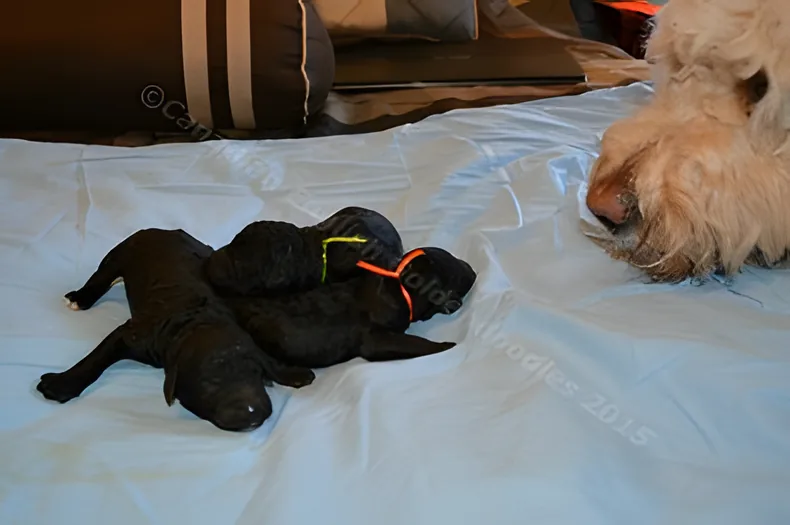
Buttercup’s puppies arrived first, at 62 days, which is full term. Her very first puppy, a male, surprised all of us: she had never seen a puppy before, and her response was to jump right out of the whelping box. Her mothering instincts took a little while to kick in, so we removed the sac and rubbed him to get him breathing, the way a mother would normally lick vigorously. Then we dried and weighed him and gave him a black ribbon (his temporary nickname was “Black Tie”). Two and a half short hours later there were ten puppies in the box, and Buttercup had settled in to show us what an amazing mother she would be.
What we saw, and what any newborn litter looks like:
- Eyes and ears are sealed shut.
- Newborn puppies can’t urinate or defecate on their own; the mother licks them to stimulate it. Seeing Buttercup do this within the first couple of hours was a huge relief.
- We gave each puppy a quick check: four legs and paws, the anus and reproductive parts, and the roof of the mouth for a cleft palate. A puppy with a cleft palate can’t nurse properly and needs a veterinarian right away.
- The first milk, colostrum, is loaded with antibodies, and puppies absorb them best in the first day. With ten puppies and only eight teats, we sat with Buttercup to make sure every puppy got its turn, because stronger puppies easily push weaker ones off, and a newborn can begin to fade within hours without eating.
- We kept watch through the first night to make sure nothing went wrong after the lights went out. It was uneventful, which is exactly what you want.
Newborns also can’t regulate their own body temperature well for the first couple of weeks, which is why they pile against their mother and each other. A warm, draft-free whelping area matters more than anything else in this stage.
Week 1: nursing, sleeping and growing
At one week, eyes and ears were still closed. The puppies were quite adept at pulling themselves around the whelping box, and the first ones were beginning tentative wobbles up on all four legs. They were very responsive to their mother; a gentle nudge from her was enough to steer them back to her warm belly. Even this early, little personality differences were starting to show.

This is also when we started Early Neural Stimulation, a set of five brief handling exercises done once a day from day 3 to day 16.
Week 2: eyes and ears open
Most puppies’ eyes open somewhere around 10 to 14 days, with hearing following close behind. By two weeks our puppies were getting up on all fours and attempting to crawl around their home — lots of wobbling — and starting to bark in cute little baby voices. We could begin to see who was more energetic and who liked to laze around, who was vocal, and who already seemed ready to play.

Week 3: walking, playing and first teeth
Three weeks is a big jump. In one of our litters, every ear had opened and the puppies could walk (on a surface with some grip), sit up, growl, play with each other, and both entertain and calm themselves. Every puppy was over four pounds. Baby teeth usually start to come in around now, too.

This is when the socialization period begins, and it’s when we started to see each puppy’s balance of dominant and submissive traits — one of the things we used later to match puppies to families. Even the strong-character puppies were showing easy-going, gentle traits, which was exactly what we hoped for.
Week 4: running, weaning and a bigger world
At four weeks our puppies could run (though not with much grace yet) and had learned that there was a world outside the whelping box that they were very motivated to explore. They had discovered their growls and calls and loved to use them, especially at 6:30 in the morning. Play-wrestling and practicing dominance on each other was constant, but the gentle nature of the litter still came through.

Weaning started around this age, helped along by very sharp little teeth — mothers let you know when they’re ready to cut back. We let weaning happen on the puppies’ own schedule and moved them straight onto a raw diet; our BARF Diet FAQ covers what young puppies eat. Whatever you plan to feed, this is also when your vet will usually talk about the first deworming.
Weeks 5 and 6: learning, exploring, going outside
Week five was one of the biggest weeks of development we saw. In a single week our puppies learned to eat and drink on their own, to keep their bed dry, and to climb stairs; they were pee-mat trained and beginning to go outside. By six weeks they were exploring the yard, and flower petals, grass and twigs were favorite things to investigate. One of our Poodle litters at six weeks was learning to come when called and to sit to be picked up in the morning.

By around six weeks puppies have their full set of 28 baby teeth, so gentle chew toys and consistent “no teeth on skin” play start to matter. Coats can also change a lot from here on: one litter looked black as young puppies but was always expected to lighten to silvers and browns as adults. If you’re choosing a puppy for a particular color, ask how the breeder expects the coat to change.
Weeks 7 and 8: manners, crates and getting ready to go home
In the last week or two before going home we exposed our puppies to as many different, safe situations as we could — one weekend the highlight was a big pile of sand. Crate training progressed to two buddies sharing a crate overnight, and the puppies were making it from 10 pm to 8 am without us. We spent one-on-one time with each puppy in the yard, where they learned to play gently even with our youngest children, and learned good house manners.

Around eight weeks each puppy had its veterinary check and microchip, and the first puppies went home to their families, already crate trained through the night.
Eight weeks is a common minimum going-home age, and it sits right in the middle of the socialization window. That’s why the AVSAB recommends starting puppy classes as early as 7–8 weeks, provided the puppy has had its first set of vaccines at least a week before the first class and has been dewormed. Socialization and vaccination aren’t either-or; your vet can help you plan both.
Weeks 8 to 12: the first weeks in a new home
Some of our puppies stayed with us to ten or twelve weeks, which gave us a good view of this stage. At eleven weeks one litter averaged over 20 lb, and they were at the age where simple obedience training was possible and the response was great. By twelve weeks they were crate trained and fully potty trained, and we were working one-on-one on leash walking and basic commands such as sit, stay and heel. Many of their infant puppy behaviors were behind them.
This is also when you start to see how big a puppy will be. Our standard-size English Goldendoodles were expected to reach anywhere from about 50 to 95 lb depending on the individual and the parents. If size matters to you, ask your breeder for the parents’ weights rather than relying on a generation label.
The socialization window starts to close around 12 to 14 weeks. Socialization doesn’t stop then, but new experiences get harder to introduce later. The first weeks at home are the time to keep up gentle, positive exposure to people, other vaccinated dogs, car rides, grooming and everyday household noise.
What this means if you’re bringing a puppy home
- Ask any breeder what their puppies experienced in weeks 3 to 8: handling, household noise, children, surfaces, car rides, crate and potty basics. That’s when the foundation is laid.
- Plan your first week around the socialization window, not just around vaccines. Our first-week guide walks through it.
- Book a puppy class early; our guide to choosing a trainer explains what to look for.
- Expect personality to keep developing. The puppy you meet at eight weeks is a good preview, not the finished dog.
What we watched for
Across the weeks of our journals we tracked the milestones any new puppy owner will want to know about: when a newborn’s eyes open, weaning, early habituation and behavior, puppy biting, grooming, vaccinations, and the early stages of house training. Watching two very different first-time mothers — one relaxed and social, one cautious and slow to warm up — go through the same journey side by side was as much a lesson in temperament as it was in biology.
Related supplies: shop puppy whelping and newborn supplies on Amazon.ca (affiliate link).
Sources
- AVSAB Position Statement on Puppy Socialization
- Clinician’s Brief: Developmental Stages of Puppies
- VCA Animal Hospitals: New Puppy Guide
Free: the Goldendoodle Puppy First-Week Checklist
A printable checklist of what to buy, what to book and what to do in the first seven days, from our years raising English Goldendoodle litters. We will also send a few short emails with our best puppy-care guides. No sales, and you can unsubscribe at any time.
The signup form didn’t load in your browser (ad blockers and some security software hide it). Open the signup form in a new tab.
Related guides
- Early Neural Stimulation — the day 3–16 exercises
- How We Raised Our Puppies — our rearing protocol
- Bringing a Puppy Home — the first week and a supplies checklist
- Our Dogs: Photo Gallery — photos from these litters